

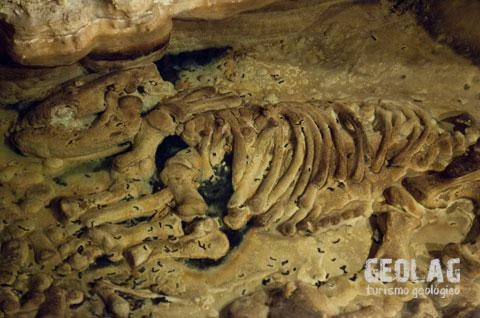
We travel to the municipality of Onís to visit one of the interpretation centers of eastern Asturias. This center of great geological interest is the only cave included within the Association of Spanish Tourist Caves (ACTE). This interpretation center complements its exhibition content with a guided tour of the La Peruyal Cave, also known as the Bear Cave, which contains the remains of a baby rhinoceros that became trapped there after accidentally falling into the cave.
Approximately 45,000 years ago, the Last Glacial Maximum covered the Picos de Europa in ice. At that time, the fauna inhabiting Asturias was very different from what we see today. Species such as mammoths, saber-toothed tigers, large cervids, rhinoceroses, and other cold-climate animals roamed freely through our region. When the ice disappeared, these species were unable to adapt to the rising temperatures and vanished from these latitudes; however, some of their remains still exist, many of them preserved after becoming trapped in the numerous caves carved out by rivers in our region.
Avín Glacial Fauna Interpretation Center
The Glacial Fauna Center is striking for its location inside the Cuevona de Avín, a natural cave whose main entrances have been closed to give the complex a more “cavernous” atmosphere.
Before entering the cave, a video sets the scene for that era and discusses the most representative species in this region. Once the video ends, the entrance to the cave opens, revealing an exhibition space that is surprising for its size, the presence of dripping stalactites, and a natural skylight through which a halo of light enters the cave.
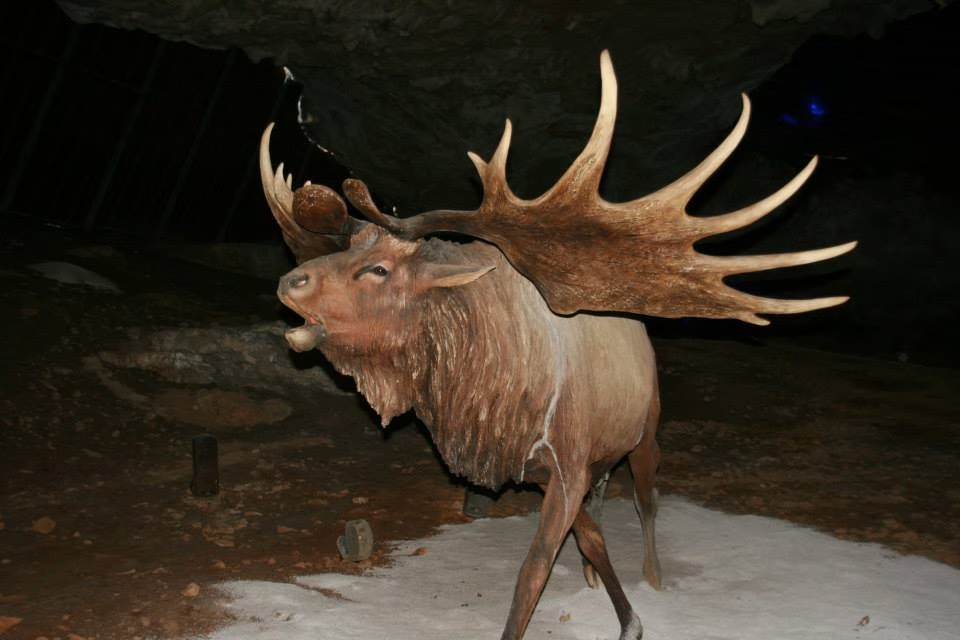
Inside, there are several life-sized models of the main species that inhabited this area during the last glacial period.
– An adult male “giant deer” (Megaloceros giganteus). The largest cervid in history, standing over 2 m tall, not including the antlers, which measured 3.5 m from tip to tip. It survived the Ice Age, with remains found in Europe dating back 7,500 years.
– An adult male woolly mammoth (Mammuthus primigenius). Similar in size to modern elephants, their bodies were covered in wool up to 90 cm long to protect them from the cold. They had tusks that could reach 4.5 m in length, a very effective tool for clearing ice. They disappeared from Europe 10,000 years ago.
– An adult specimen of a large feline (Homotherium latidens). This was a feline from the “saber-toothed” group and the Panthera leo family. Its size was similar to that of a modern lion, and its body was adapted for running, capable of reaching speeds of 96 km/h. Its most striking feature is its upper canines, which are twice the size of a lion’s canines. It disappeared from Europe 10,000 years ago.
– In a corner of the cave, we can observe a reproduction of three Neanderthals around a fire. This species found its last refuge in Spain, disappearing 24,000 years ago. The guide will explain the habits and characteristics of these cave dwellers who surely coexisted with Homo sapiens at some point in history.
– An adult female and an 18-month-old calf of the “steppe rhinoceros” (Stephanorhinus hemitoechus). This is the star of the visit, as it is the species of the La Peruyal fossil and the first life-sized recreation of this species. The most common rhinoceroses at that time were woolly rhinoceroses, so the discovery of the La Peruyal rhinoceros—with its sharper snout and much more compact build than the woolly variety—adds additional interest to the find.
The entire tour takes place on a wooden walkway, suitable for all audiences, including wheelchair users and children. The walkway is elevated as the Riu Chicu meanders through the middle of the cave.
At the cave exit, a replica of the rhino’s fossil skeleton allows us to see the appearance of the find discovered in the 1970s in the La Peruyal cave, where the difficulties in its identification are explained. It was not until 2001, following detailed anatomical studies, that it was concluded to be a rhinoceros.
The visit to the center is completed with a mineral collection and explanatory panels about the mines and fossils of the area. Tours of the Cuevona are always guided. They last approximately 45 minutes and start on the hour.
Opening Hours:
From July 10 to September 10:
Morning: 11:00 AM to 1:00 PM.
Afternoon: 4:00 PM to 8:00 PM
The rest of the year, visits to the Glacial Fauna Center are by telephone reservation only. 616212483 / 608281990 / 652901650
The Pozu La Peruyal or the Bear Cave
Regarding the visit to the La Peruyal cave, it has been open to the general public since mid-July. Visits will continue until September 30, and advance booking is required as only two groups per day are allowed, with a maximum of 8 people each. Visits will be managed by the “Destino Picos de Europa” society, and Pablo Solares will be in charge of guiding them through the interior of the cave.
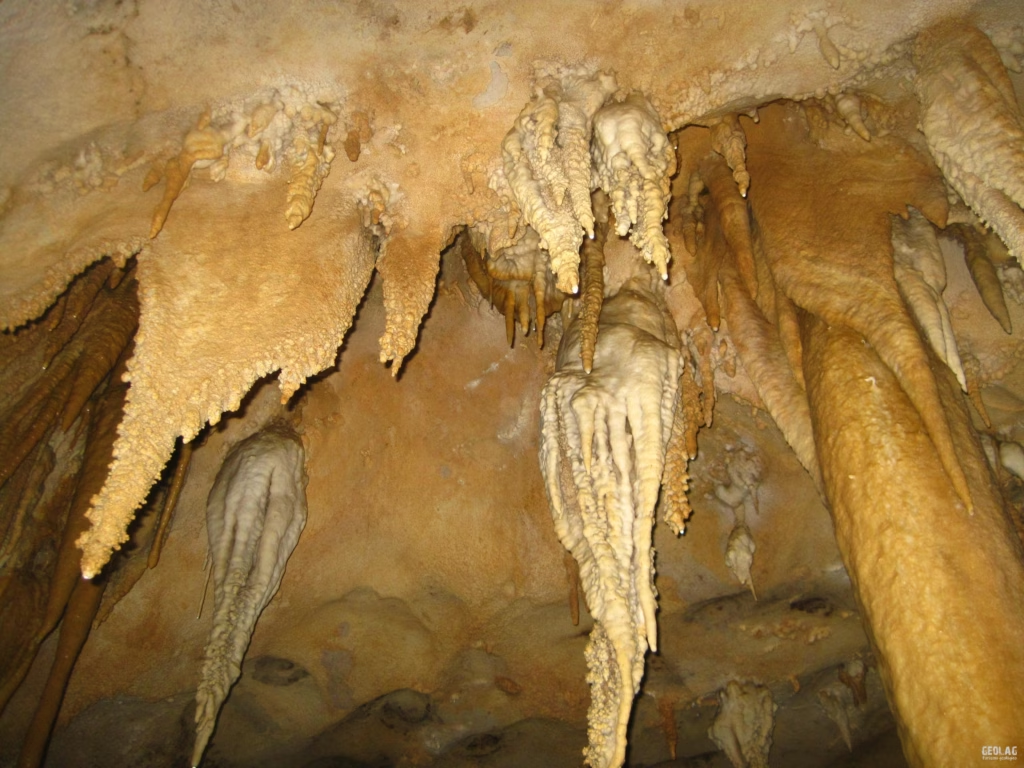
At the entrance, a staircase has been installed to allow visitors to descend the 50 m between the cave and the surface without difficulty. Although it is a short-distance cave with low difficulty, a certain degree of agility is required to visit it, as there are steep sections where we must progress by holding onto knotted ropes. At the bottom of the cave, the location of the rhinoceros fossil within a pool and surrounded by stalactites like a sanctuary is surprising. The sight is beautiful, and all around we will see various typical cave formations that will undoubtedly amaze us.
This cave, like all those formed in limestone areas, was sculpted by an underground river that suddenly disappeared due to the collapse of one of the cave entrances. However, the remains of the work carried out by the river in the cave are still preserved, with material carried by the waters observed perfectly stratified in horizontal layers, primarily mud and calcareous crusts. On the walls, notches corresponding to the different levels reached by the waters before disappearing can be seen, and on the gallery ceiling, erosions known as “scallops” indicate that water once circulated through this gallery, filling it entirely to the ceiling. These marks also indicate the direction the current followed.
During the guided tour, an approved helmet with LED lighting and a caving oversuit (made of Cordura rather than fabric) will be provided. Visitors must bring sportswear to wear under the suit and appropriate footwear.
Reservations at 616 21 24 83 or at the Glacial Fauna Interpretation Center.
Documentation
To learn about the fossil rhinoceros: The fossil rhinoceros of “Pozu La Peruyal” (Onís, Asturias). Sautuola / XII Institute of Prehistory and Archaeology Sautuola Santander (2006), 409-420.
To get around the area: 1:80,000 scale map of Picos de Europa and the Eastern Coast. Ediciones Adrados. 1:50,000 scale map of Picos de Europa. Ring of Refuges. Ediciones Adrados.
Would you like to discover this landscape with a geologist?
GEOLAG organizes educational routes adapted to families, groups and educational centers.
Request information about this route