

To highlight the elements that make up the geodiversity of a region, the global Geosites network has been created, which takes into account geological contexts and sites of international importance. Part of the geological history of the Earth is written in these geological sites, which has a direct relationship with education and raising public awareness of the environment. The selection of geological representatives constitutes a first step in determining the geological heritage of a territory, which, over time, will become the basis for geological conservation and geotourism.
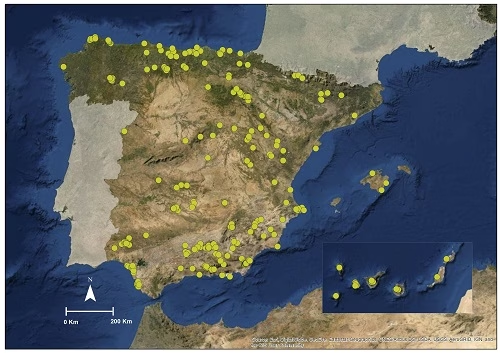
Geosites Map
See link: “Sites of Geological Interest” in Spain: https://info.igme.es/ielig/
In Asturias, 5 of the 20 contexts considered in the Global Geosites network as sites of geological interest of international relevance are represented. These sites and contexts are:
- El Sidrón Cave, included in the geological context of “Pliocene-Pleistocene vertebrate deposits of Spain”
- The El Caleyo amber deposit, which is included in the context of “Fossils and ichnofossils of the Lower Cretaceous of the Iberian Peninsula”
- The Devonian Reef and platform of Arnao, which represents the context of “Stratigraphic series of the Lower and Middle Paleozoic of the Iberian Massif”.
- Demués in the Gamonedo-Cabrales Area (Picos de Europa), the Sierra del Cuera, and the cliffs of San Antolín-La Huelga (Llanes) are the Asturian representative sites of the “Carboniferous carbonate platform margins”.
- The Picos de Europa is also included in the context called “Karst systems in carbonates and evaporites of the Iberian Peninsula and Balearic Islands”.
However, Asturias and, by extension, the Cantabrian Range in which it is framed, conceals many more sites of geological interest. At GEOLAG, we are committed to discovering the landscapes, mountains, waterfalls, caves, fossil and mineral outcrops, or archaeological sites that, in addition to impressing with their beauty, have great cultural importance due to the historical dimension that Geology has as a science. Through many of these sites, we can come to understand how our planet has evolved from its beginnings and what its future evolution will be. The history of the Earth is written everywhere!
Would you like to discover this landscape with a geologist?
GEOLAG organises educational routes adapted to families, groups and schools.
Request information about this route