

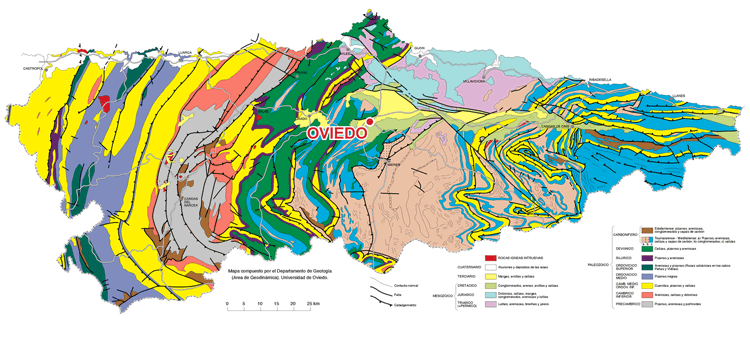
The central region of Asturias, where the municipality of Oviedo is located, contains a wide variety of rocks that are part of the La Sobia-Aramo Unit. These are Paleozoic rocks overlain by the Mesozoic-Tertiary Cover in a discordant manner.
THE UNDERGROUND OF OVIEDO
The oldest rocks found in the municipality of Oviedo date from the Ordovician, represented by the Barrios Quartzite, which in the San Andrés de Trubia area is folded into a large anticline. Remember that an anticline is a fold in which the oldest rocks are at the core.
Interestingly, in our municipality, the oldest rocks—the Paleozoic ones—are the ones that form the main landforms, such as the Naranco or the Aramo, while the more recent ones form low-lying areas such as the one on which the city of Oviedo is situated (Oviedo, San Claudio, Colloto, Santa Marina de Piedramuelle, and La Manjoya).
Construction Issues
Oviedo’s subsoil consists of a wide variety of rocks with low cohesion and numerous faults that cause the materials to be stepped, which, combined with the presence of aquifers, makes it difficult to support underground structures (parking garages, tunnels, etc.). Groundwater often seeps to the surface, making construction techniques complex and driving up the final cost of the projects. The best area to build in Oviedo is the old town… Máximo and Fromestano didn’t know a thing…
WATER IN OVIEDO
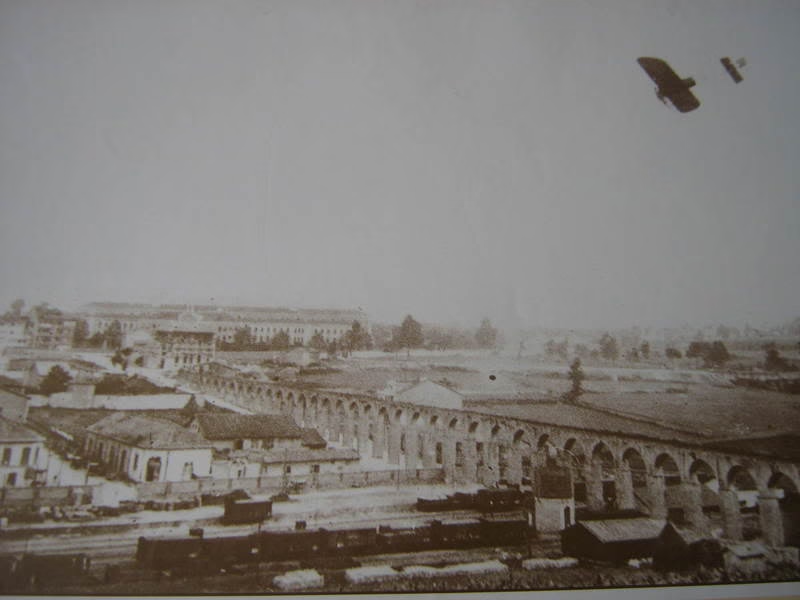
Although Oviedo’s subsoil is rich in aquifers, the city’s water supply relied on springs flowing from nearby areas, such as those at San Esteban de las Cruces and Fitoria. Thus, in 812, the will of Alfonso II the Chaste mentions an aqueduct that carried water from San Esteban de las Cruces to Oviedo. The Foncalada fountain was part of a large hydraulic complex that regulated irrigation in the Santullano floodplains. Similarly, in 1570, construction began on the Los Arcos aqueduct (41 pillars), approximately 400 m long and 10 m high, which would carry water to Oviedo from the Naranco, drawing on the Fitoria spring.
Fontán Pond: There used to be a pond in the area where Oviedo’s market stands today, until 1523, when every resident was asked to bring a cauldron filled with fill dirt to pour into the pond. Little by little, it was filled in to prevent health hazards. Today, the Fontán fountain itself marks the original ground level.
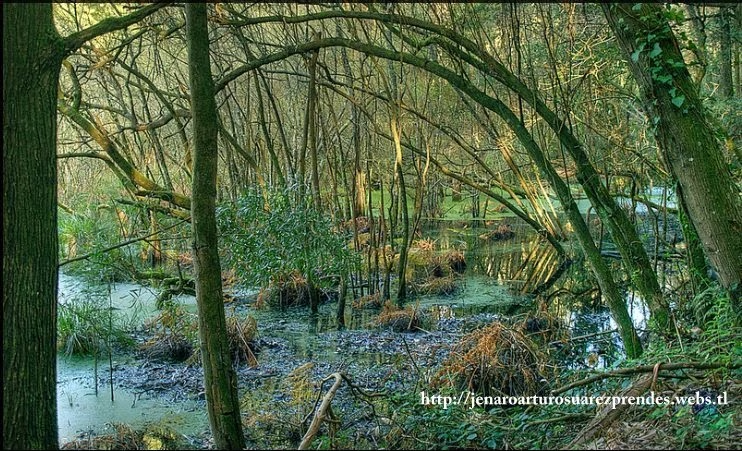
Torollo Pond: The mining of Cretaceous clay in the San Claudio area to make roof tiles and bricks has resulted in the creation of a very unique and rare habitat in our municipality. It is a semi-artificial pond about 80 m in diameter that was formed in the mid-1960s. It is home to 86 species of birds—including nightingales, goldfinches, and robins, as well as herons, sparrowhawks, and owls—along with an interesting variety of insects, including species of Community interest, and amphibians. El Torollu is a marshy alder grove and, as such, a habitat of Community Interest. There used to be an old washing place and a spring here where women would come, but everything was lost amid the rubble. Although a request was made to include it in the Network of Protected Areas as a Natural Monument, the request was denied.
Hot Springs: In Las Caldas de Priorio, the spa was built in 1776 and served as a summer resort for the bourgeoisie in the 18th century. Its waters, at 43°C, have a concentration of radioactive elements higher than permitted levels (which is normal for this type of hot spring). It appears that this concentration decreases within 20 days.
Caves: The action of water inside the limestone formations in the municipality of Oviedo has carved out hundreds of kilometers of passages. There are more than 30 caves, almost all of which are located in Carboniferous limestone. Some of them contain cave paintings and other prehistoric art, while others have yielded fossil remains of animals such as a proboscidean (a type of elephant), horses, various types of goats, wild boars, bears, deer, and a steppe bison.
OVIEDO MINERALS
There are three main minerals that have been mined since ancient times in the municipality of Oviedo:
- Coal: No mineral is more synonymous with Asturias than coal, and in the municipality of Oviedo there were several mines in the coal-bearing rocks of Naranco (the Tarabica and Inesperada mines), which remained in operation until the 1960s, as well as the numerous mines in Olloniego (San José, Campa del Trave, Artemisa), which remained active until 1992.
- Iron: In Oviedo, there are two rock formations rich in iron: the Furada Formation (Silurian) and the Naranco Formation (Devonian). Mining operations related to the Naranco sandstones took place in Naranco, La Grandota, Olloniego, and San Claudio. In 1909, these mines accounted for nearly 20% of total iron production. The ore was destined for the blast furnaces at the Trubia and Mieres steel mills. To transport the ore from the Naranco mines, a railroad was built in 1880 that followed the route of the Finnish-style track. It was 7.5 km long, running from the Orgaleyu limestone quarry to the RENFE loading dock.
- Gypsum: These rocks date back about 40 million years, when the landscape in Oviedo resembled a modern-day sebkha (similar to those found in Tunisia, Oman, or Libya). There are two gypsum deposits in Oviedo, one in Llamaquique and the other in Ventanielles-La Corredoria. Gypsum quarries have existed in Llamaquique since the 16th century. In the 1920s, the remains of a tapir-like herbivorous mammal (Palaeotherium magnum)—a species of African origin previously unknown in the region—were discovered in that area. A turtle and rodents were also found. There are some references to a plaster factory near the gas plant (on Paraíso Street).
QUARRIES OF OVIEDO
They are located near consumption areas, since the price of aggregate doubles at 30 km and quadruples at 136 km. In fact, Oviedo accounts for the largest share of limestone quarry production in all of Asturias (64%). This limestone is used for concrete, cement, fluxes, or as ornamental stone.
In Oviedo, limestone is the primary material mined (46% of aggregates are limestone), such as the deposits found in Naranco and Las Caldas. Sand is the second most common type of rock in production (33%), such as that extracted from the sand pits in La Eria (La Argañosa); there were also clay quarries at tile factories and brickworks such as those in San Claudio and San Esteban de Las Cruces, and sandstone was quarried to a lesser extent.
Ceramics from Oviedo
The San Claudio pottery factory was one of the most prestigious in Spain. Pottery is a mixture of clay, kaolin, silica, and feldspar that is waterproofed with a glassy glaze. The San Claudio factory never used local materials, as it sourced its clay from England and its kaolin from Burela (Lugo).
In contrast, the Faro Pottery Workshop did use clay from Faro and San Esteban de las Cruces, and at one point there were as many as 70 potters; that is why it was said that there was not a single house in Faro without a kiln or a potter. Today, only the Vega family carries on the pottery tradition. They did not use a potter’s wheel but rather a very primitive type of wheel.
Two types of pottery are made in Faro:
- Black pottery made from a mixture of three types of clay rich in iron and other metals, fired at high temperatures. This pottery is extremely durable and has a metallic sound and luster.
- This white-glazed pottery is extremely rare, as there are traditionally no other examples of this type found north of Zamora; it is painted in green, yellow, or blue, featuring plant and animal motifs, most notably the Páxara—half fish, half bird—a symbol of fertility in Mycenaean cultures.
Ornamental and Construction Stones—Stately Buildings
Three main types of rock were used in the construction of the capital’s major buildings. These rocks were quarried from more than 30 sites. They were used in both civil and religious buildings.
- Piedramuelle Stone (Cretaceous limestone and calcareous sandstone): From the 14th to the 16th centuries, this stone was used in San Julián de los Prados, Santa María del Naranco, San Miguel de Lillo, La Foncalada, the Cathedral, the University building, the Reconquista Hotel, the Archaeological Museum, urban palaces (Toreno, Camposagrado, Valdecarzana), the Museum of Fine Arts, the Los Pilares Aqueduct, the Plaza del Fontán, the city walls, and City Hall.
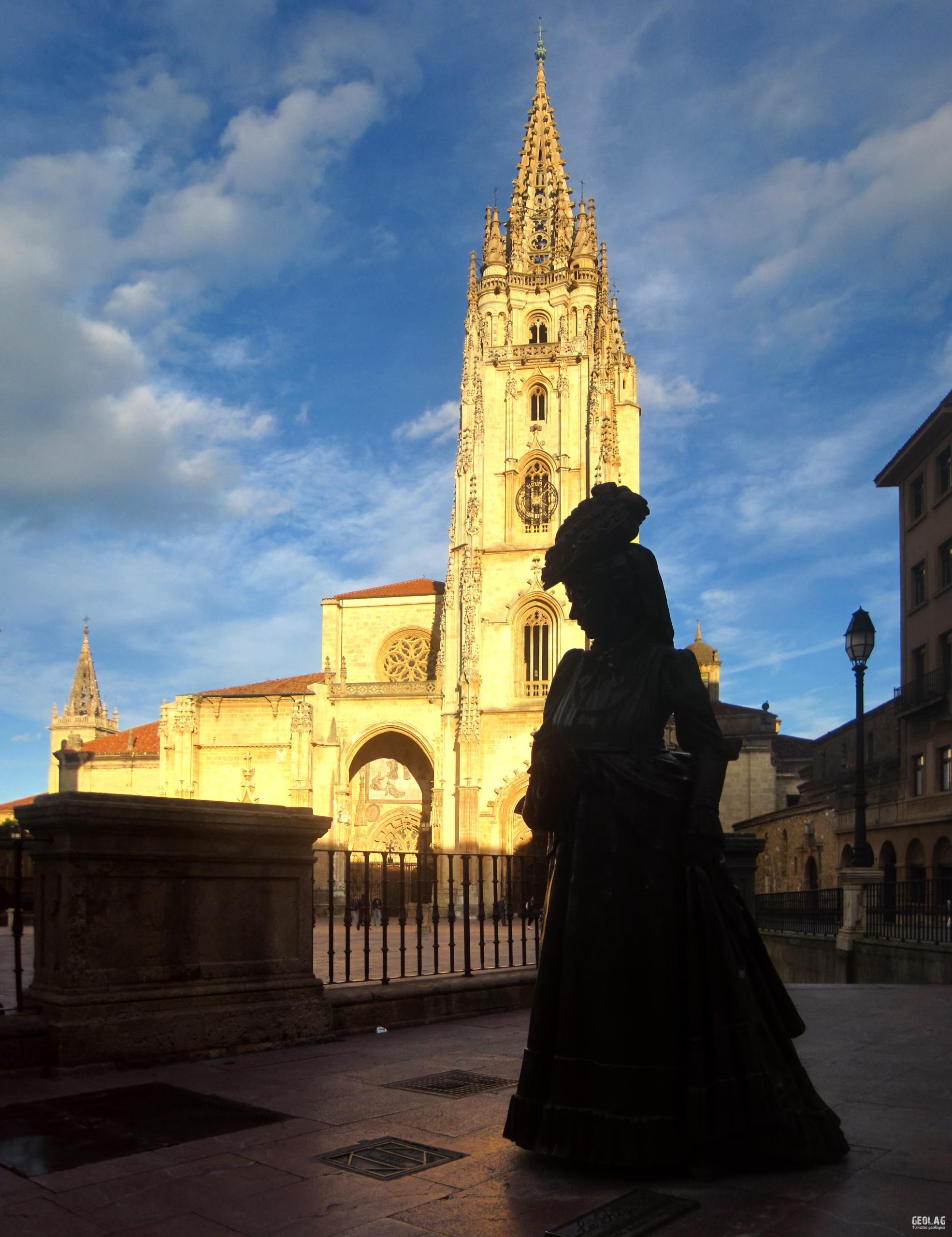
- Laspra Stone (Whitish, marly limestones from the Paleogene period). There was once a quarry at El Cristo de las Cadenas, where the sports facilities stand today. Because it was easy to carve, this stone was used for ornamental purposes in noble buildings from the 9th to the 16th centuries, most notably in the interiors and parts of the exterior of the Cathedral.
- Tiñana Stone (Cretaceous bioclastic limestone). Quarried in the La Fozana neighborhood (Siero): Used in the reconstruction of the cathedral in 1943 because it closely resembles Piedramuelle stone.
In Oviedo, a distinction is made between two parts of the city based on the type of stone used in their buildings: “Yellow Oviedo” and “Gray Oviedo,” the latter home to the buildings of the late 19th- and early 20th-century urban expansion, many of which are located around the central Uría Street.
Decorative rocks and gemstones
Although our quartz, amber, and jet are not of the highest quality and have not been used as gemstones, their scientific value is undeniable.
- Smoky Quartz from Las Caldas: These are dark-colored bipyramidal quartz crystals, also known as Las Caldas Diamonds.
- Amber from El Caleyu: Located in El Caleyu, 5 km from Oviedo. Although Jovellanos claimed that Oviedo amber was the best in Europe, almost all authors agree that Oviedo amber is of no interest because it is highly fractured and could only be used as incense. However, even though it cannot be used as a gemstone, previously unknown insects, spiders, seeds, and other specimens have been found inside it—all representing the flora and fauna that lived in Oviedo some 100 million years ago. That is why it has been designated one of the 144 Sites of Geological Interest in Spain for containing Cretaceous fossils (Geosite FC-08). There are other geosites of this type in Teruel, Álava, and Burgos.
- Jet from La Manjoya: Of little hardness and scant interest. Behind the church of San Tirso, a jet workshop has been discovered that, according to those in charge of the excavation, could be “the oldest in the world.” Perhaps jet from Oviedo was even worked in that workshop—who knows…
Sources consulted
- Historic Quarries of Oviedo: A Contribution to Architectural Heritage (2013). Manuel Gutiérrez Claverol, Carlos Luque Cabal, and Luis Alberto Pando.
- Geology of Oviedo: Description, Resources, and Applications (1995). Manuel Gutiérrez Claverol and Miguel Torres Alonso.
Would you like to discover this landscape with a geologist?
GEOLAG organises educational routes adapted to families, groups and schools.
Request information about this route