

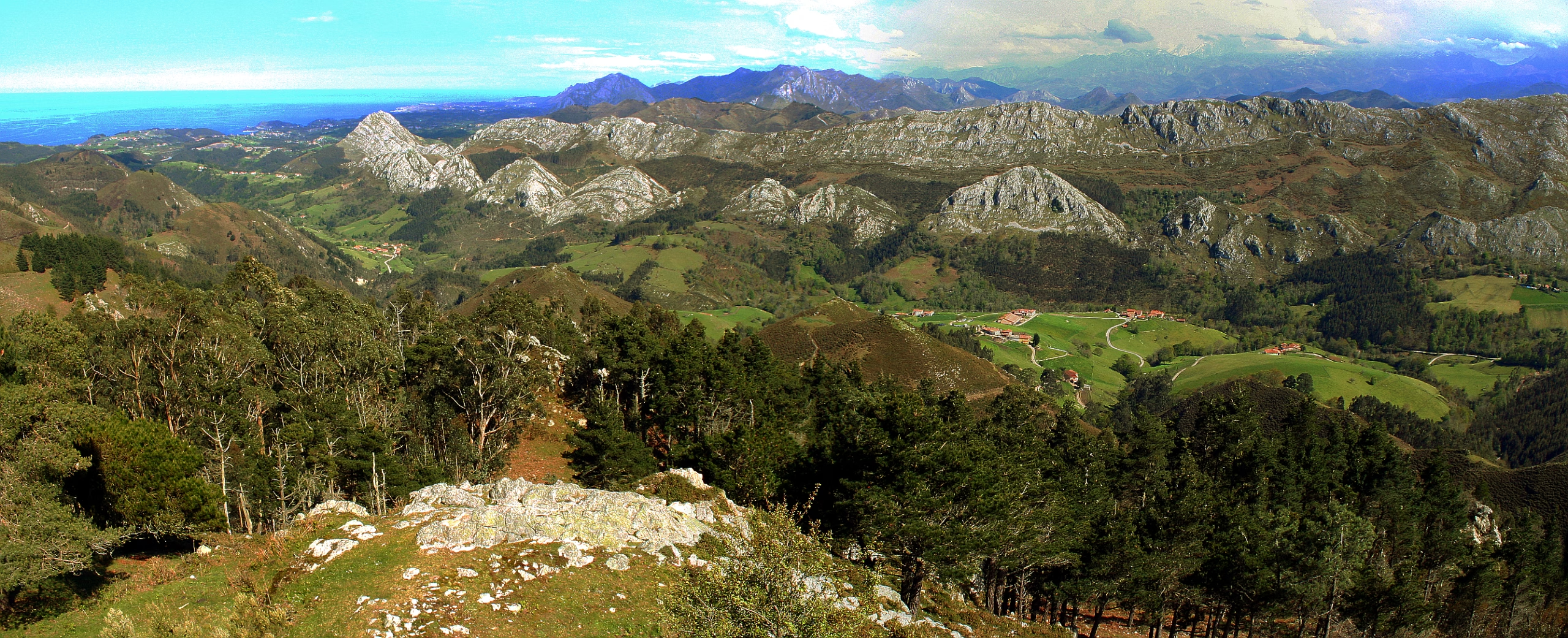
The Sierra del Sueve rises along the Cantabrian Sea, between the municipalities of Colunga, Caravia, Parres, and Piloña. From sea level, we climb to the 1,161-meter summit of Picu Pienzu in less than 4 km, reaching one of the best viewpoints overlooking the Cantabrian Sea and the Picos de Europa.
It can be reached via the road connecting Infiesto and Colunga, passing through the La Llama Pass (AS-258) and the road from Arriondas to La Torre (AS-432). It can also be reached via the N-632.
You’ll need two cars: one will be left in the parking lot of the old Casa Julia bar in the village of Loroñe, and the other at Alto de La Llama, where we’ll begin our hike. From Alto de La Llama, we’ll take the trail that leads to Majada de Espineres, where we’ll venture into the highest part of this mountain range. The total duration of this hike will be about 7 hours, including stops for lunch and to enjoy the scenery.
Because this mountain range acts as a barrier to the mist coming in from the sea, fog is a common occurrence in this area, which is why it has earned the nickname “the kingdom of fog.”
This coastal mountain range has been awaiting designation as a Protected Landscape since 1994; let’s hope its final designation isn’t too far off.
The Rocks of the Sueve
This is a limestone massif whose slopes present stark contrasts. On one hand, the northwestern slope, which we will climb toward Espineres, has a gentle slope due to the presence of slate, limestone, and sandstone, contrasting with the steep southeastern slope, dominated by quartzite—a very resistant rock that creates a steeper incline. In the summit area, where our route runs, mountain limestone is omnipresent throughout the entire route.
Due to the presence of limestone—a permeable rock—all the water that falls on the Sueve tends to seep into it, forming the main landforms: sinkholes. These are depressions with rounded outlines that, like funnels, channel surface water; these karstic depressions are called dolines and represent the most interesting morphological feature of the Sueve. Inside many of these karst depressions, there are small groves of holly and blackthorn that serve as a refuge for an ever-growing population of fallow deer.
The Fallow Deer
This species was introduced into the Sueve region in 1960 for hunting purposes. The absence of predators and harsh environmental conditions has led to a continuous increase in the fallow deer population, which could become a destabilizing factor; as a result, the population has been controlled on several occasions through selective hunting. Subsequently, an attempt was made to reintroduce red deer, although this effort was not as successful, as almost all the animals migrated; today, a few isolated individuals remain in the vicinity of the Biescona beech forest.
The Asturcón Festival
But among all the animal species of the Sueve, the true masters of these mountains are the Asturcóns. Their origins date back to ancient times; in fact, Pliny already mentioned their existence in 80 BC, making them one of the oldest and purest pony breeds in the world. For those who have never seen them, Asturcón ponies typically have jet-black coats and long manes, and they usually have a white star on their foreheads.
On the second-to-last Saturday in August, the Asturcón Festival—designated a festival of regional tourist interest—is celebrated in Majada de Espineres. This festival was conceived in 1980 to protect this breed of horses, which at that time was in danger of extinction, with barely 40 remaining. Today, there are more than a thousand.
The celebration begins in the morning with an outdoor Mass, a regional dance contest, brass bands, bagpipe bands, and a fellowship meal, followed by a horseback riding exhibition, dressage, and the branding of foals born that year. The “Pastor Mayor del Sueve” is also named, and the “Asturcones de Oro” awards are presented.
In mid-October 2012, the book *El poni celta: L’Asturcón ya’l Shetland* was presented. It was written by Antón Álvarez Sevilla (President of the Asturcón Foundation) and published by the Belenos Foundation.
El Pienzu 1,161 m
The hike begins at Majada de Espineres and crosses the entire ridge heading east. Along the entire route, we’ll enjoy splendid views of the coastline of Colunga, Caravia, and Ribadesella to our left and of the majestic Picos de Europa. Near the end of this broad ridge, Pico Pienzu stands out; climbing it is highly recommended for the excellent views from its summit. Once you reach the summit, you’ll descend south toward the Beluenzo Pass. From this pass, take the trail to the left that leads to La Biescona.
La Biescona
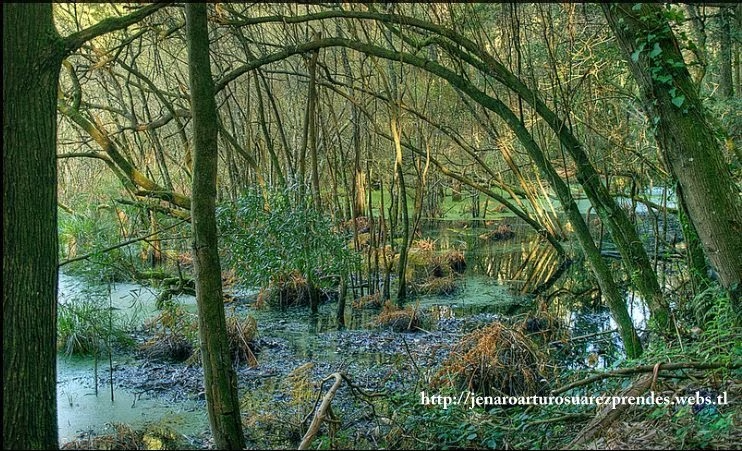
The Biescona Beech Forest is the lowest-altitude beech forest in Europe, situated just 200 m above sea level, where environmental conditions are ideal for the growth of these trees, which are more typical of continental climates and higher elevations. It features trees with crown diameters of around 30 meters and trunk circumferences of more than 5 meters. The understory is dominated by large ferns, giving this forest a very “tropical” appearance.
The Mines of Sueve
Deep in the forest, almost hidden by the lush vegetation, we can see the ruins of a mining complex where copper was once mined and which provided jobs for many people in the surrounding area.
Some sources trace the place name “Sueve” back to the Celtic word *shulva* = copper, which highlights the significant copper deposits found in this region.
Tejeda del Sueve
On the northernmost slope of the Sueve Mountains lies one of the largest concentrations of yew trees (Taxus baccata) in all of Europe and one of the continent’s oldest forests. The forest consists of more than 8,000 yew trees and covers an area of 80 hectares. According to a study by the newspaper El Mundo, this forest is the eighth most important in Spain.
I would like to take this opportunity to call for the Sueve Landscape, as well as the forests of La Viescona and La Tejeda del Sueve, to be included in the Network of Protected Areas of the Principality of Asturias.
To see more photos, click here
I would like to dedicate this route to David Mateos, who accompanied me on this journey and who, sadly, lost his life in an accident just a few weeks later. May he rest in peace.
Additional Documentation
- sierradelsueve.es
- “The Celtic Pony: The Asturcón and the Shetland,” by Antón Álvarez Sevilla. Published by the Belenos Foundation.
- Main image: Panoramic view of the mountain ranges in Asturias, from the El Fito lookout point, by Mario Modesto, via Wikimedia Commons. License CC BY-SA 3.0.
In mid-October 2012, the book *El poni celta: L’Asturcón ya’l Shetland* was presented. It was written by Antón Álvarez Sevilla (President of the Asturcón Foundation) and published by the Belenos Foundation.
Would you like to discover this landscape with a geologist?
GEOLAG organises educational routes adapted to families, groups and schools.
Request information about this route